
How to use a compass
Updated 5 August 2026
A compass answers exactly one question — which way am I facing — and it answers it in the rain, under a canopy, with a dead battery. This guide covers the parts that matter, taking and holding a bearing, the back bearing that gets you home, and where the compass in your phone quietly lies to you.
The five parts that matter
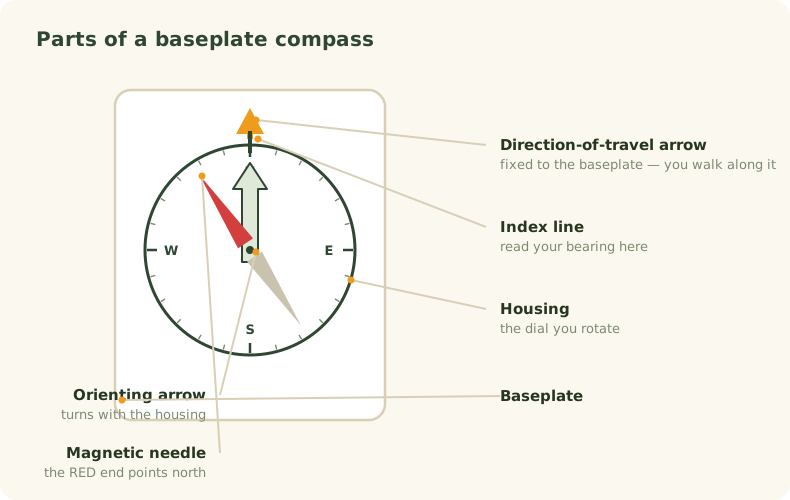
Any baseplate compass, from a £10 one to an expensive Silva, has the same working parts:
- The needle. The red end points to magnetic north. Always. This is the single most common mistake — people follow the white end.
- The housing (the rotating dial) with 360 degrees printed around it.
- The orienting arrow, outlined inside the housing floor and turning with it.
- The direction-of-travel arrow, printed on the baseplate and fixed. This is the one you walk along.
- The index line, right where the housing meets that arrow — it is where you read your number.
Which way is north — the ten-second version
Hold the compass flat in your palm, level, in front of your chest. Let the needle settle. The red end is north; behind you is south, right hand east, left hand west.
Flat matters more than people expect. Tilt the compass and the needle drags on the capsule and lies to you. Level, waist height, arms relaxed.
Taking a bearing and actually following it
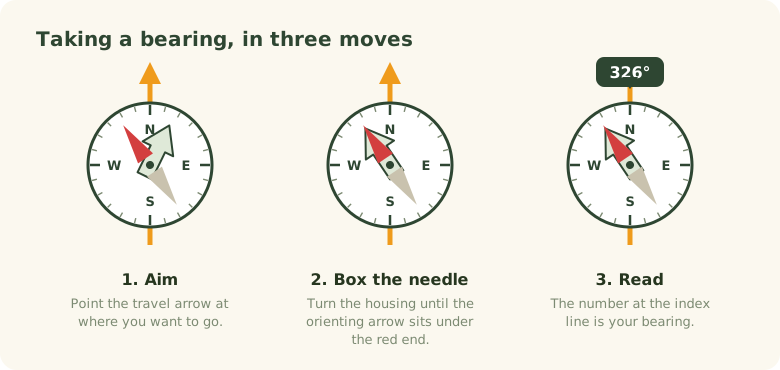
A bearing is just a number between 0 and 360 that means "this direction". Here is the whole method:
- Point the direction-of-travel arrow at where you want to go.
- Turn the housing until the orienting arrow sits under the red needle. The phrase every instructor uses is "put red Fred in the shed", and it sticks because it works.
- Read the number at the index line. That is your bearing — write it on your hand.
- To walk it: hold the compass in front of you, turn your whole body until red Fred is back in the shed, and walk where the travel arrow points.
Try it in the browser → a working compass you can turn: set the dial, box the needle, read the number.
The trick that stops you drifting
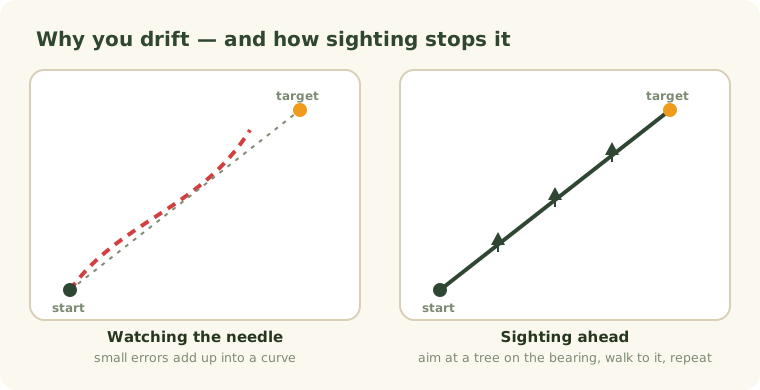
Nobody walks a straight line by staring at a needle. Instead, sight along your bearing to something distinctive fifty or a hundred metres ahead — a leaning trunk, a boulder, a gap. Put the compass away, walk to it, take the bearing again, pick the next object. Repeat.
This is how you cross a forest without curving. It also lets you go around a marsh or a thicket and pick the line back up on the far side.
The back bearing — this is the one that gets you home
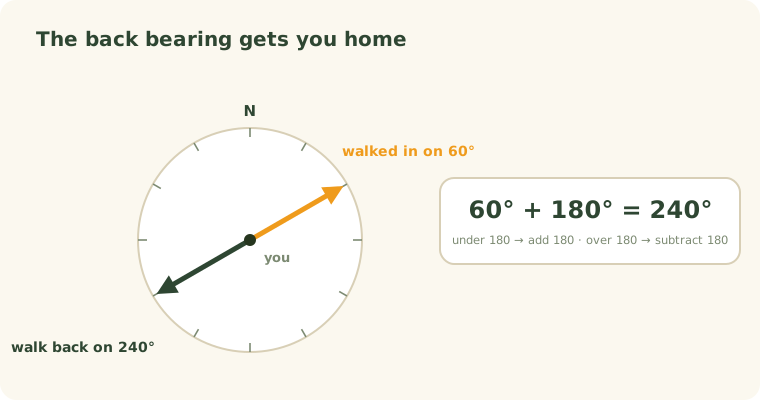
If you walked in on a bearing of 60°, the way back is 60 + 180 = 240°. If the number is above 180, subtract instead: walked in on 300°, return on 120°.
Note the bearing at the moment you leave the road. That one number, plus roughly how long you walked, is a genuine plan for getting out — far better than the vague sense that the car is "over that way".
The catch: it only works if you kept that bearing on the way in. Wandering after mushrooms is exactly the activity where you do not. Which is why recording the actual path you walked beats reconstructing it.
Magnetic north is not true north
Your needle points at the magnetic pole, which is not the North Pole and keeps moving. The gap between them — declination — depends on where you are standing: near zero across much of Europe, up to 15–20° in parts of North America.
For a walk in the woods with a phone as backup, you can ignore it. For map work over long distances, you cannot: 10° of error is roughly 175 metres off after a kilometre. Paper topo maps print the local declination in the margin; the value for any coordinates is also on the NOAA magnetic field calculator.
Using a compass with a map
- Lay the map flat and put the compass edge along the line from where you are to where you want to be, travel arrow pointing the way you are going.
- Turn the housing until its printed lines are parallel with the map's north–south grid lines, "north" on the dial to the top of the map. Ignore the needle entirely for this step — it plays no part yet.
- Read the bearing, adjust for declination if it is significant where you are, then stand up and walk it as above.
Using a compass without a map
Most people in a forest have no map, and a compass alone still helps — but only for one job: holding a straight line. It cannot tell you where you are. What it can do is stop the circling, so that "walk west until I hit the road" actually ends at the road.
Which means the useful question is not "where am I?" but "what do I know that lies in a line?" A road, a river, a power line, a lake shore — anything long enough that you cannot miss it if you walk perpendicular to it. Aim for the feature, not the point.
The compass in your phone
Your phone has a real magnetometer, and it works with no signal at all — see does GPS work without internet. Two things to know:
- Calibrate it. The figure-of-eight wave is not superstition: it re-references the sensor. Do it whenever the reading looks odd.
- Keep metal away. Magnetic phone cases, car dashboards, a knife in the same pocket, MagSafe holders — all of them drag the reading by tens of degrees. A phone compass consulted on a car bonnet is simply wrong.
A real compass has one advantage worth respecting: it does not run out of battery.
No compass at all
- The sun. Rises roughly east, sets roughly west, and at local noon sits due south in the northern hemisphere. Rough, but enough to hold a line for an hour.
- An analogue watch. Northern hemisphere: point the hour hand at the sun; halfway between the hour hand and 12 is south. Accurate to about 20°, and worse under daylight saving.
- A shadow stick. Plant a stick, mark the shadow tip, wait fifteen minutes, mark again. The line from first mark to second runs roughly west to east.
- Moss on the north side is a myth. Moss grows where it is damp and shaded, which depends on the tree, the slope, and the wind. People have walked in circles for hours trusting it.
Common questions
Which end of the needle is north? The red one, on essentially every compass made.
Does a compass work in the forest? Yes — canopy affects GPS, not magnetism. Iron-ore ground and power lines can deflect it locally; step twenty metres and re-check if a reading looks wrong.
Does the phone compass work offline? Yes. It is a sensor, not a service.
Do I need to know all this to pick mushrooms? No. You need one thing: a way back to where you started. A compass is one way; the bearing you noted at the road is another; a recorded track is the one that survives an afternoon of wandering.