
How to find north without a compass
Without a compass you still have the sun, a stick, a watch and — at night — one star. Here is what actually works, how accurate each method is, and the myths that send people walking in circles. And the one thing north will not tell you: where your car is.
Short answer: the best compass is the one already in your phone — it works with no signal. Without it: by day, the sun at midday is due south, and a shadow stick gives you a west–east line in twenty minutes; by night, follow the Big Dipper to the North Star. Moss, anthills and tree rings are myths.
| Method | When it works | How accurate |
|---|---|---|
| Phone compass | Any time, no signal needed | Good — calibrate it and keep metal away |
| North Star (Polaris) | Clear night, northern hemisphere | Within about one degree |
| Sun at midday | Sunny, around local noon | Good — the sun is due south |
| Shadow stick | Sunny, 15–20 minutes | An approximate west–east line |
| Analogue watch | Sunny | Rough — 20° off or more |
| Moss, anthills, tree rings, branches | — | Unreliable: do not use |
First, the compass you already carry
Your phone has a real magnetic sensor, and it works in airplane mode, with no signal, anywhere — see does GPS work without internet. Two habits make it trustworthy: wave the phone in a figure of eight when a reading looks odd, and hold it away from metal — magnetic cases, a knife in the same pocket, a car bonnet. How to read it properly: how to use a compass.
Everything below is for the day the battery dies.
The sun: east, west — and due south at midday
"The sun rises in the east and sets in the west" is only exactly true around the equinoxes in March and September. In summer in the northern hemisphere it rises in the north-east and sets in the north-west; in winter, in the south-east and south-west. Good enough to hold a rough line, not to aim at a road.
The precise moment is local noon: then the sun stands due south (anywhere north of the tropics), and shadows point due north and are at their shortest. Local noon is rarely 12:00 on your watch — time zones and summer time put it anywhere from about 12:00 to 13:30. The shortest shadow is a better clock than the watch.
The shadow stick
- Push a straight stick upright into flat, open ground.
- Mark the tip of its shadow with a pebble.
- Wait 15–20 minutes.
- Mark the new position of the tip.
- The line from the first mark to the second runs west to east. Stand with the first mark on your left and the second on your right: you are facing north.
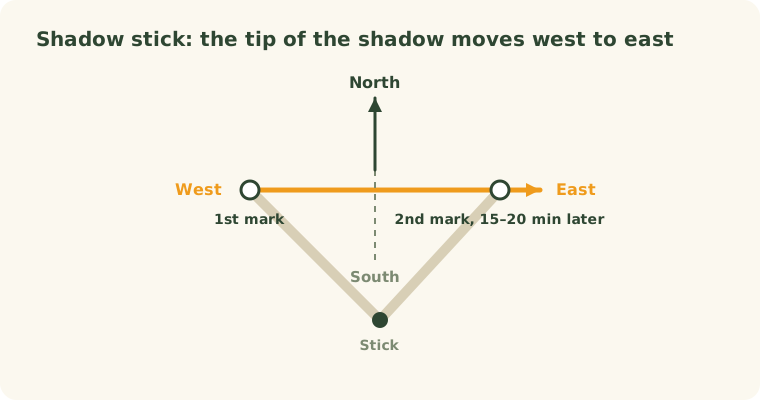
It works anywhere the sun casts a shadow and is most reliable around midday. Its weakness is the forest itself: you need a patch of sun on flat ground, which means a clearing, a track or a forest edge.
The watch method — rough
In the northern hemisphere: point the hour hand at the sun; halfway between the hour hand and the 12 is south. On summer time, use the 1 instead of the 12. In the southern hemisphere, point the 12 at the sun; halfway between the 12 and the hour hand is north.
Be honest about it: the error is easily 20° and more, worst in summer around midday. Use it to keep walking in roughly the same direction, never to aim at something you cannot see.
At night: the North Star
Find the Big Dipper. Take the two stars at the front of its bowl — the pointer stars — and extend the line through them about five times their distance apart. You arrive at Polaris: a moderately bright star standing on its own, the end of the Little Dipper's handle. Straight down from it, on the horizon, is north, within about a degree.
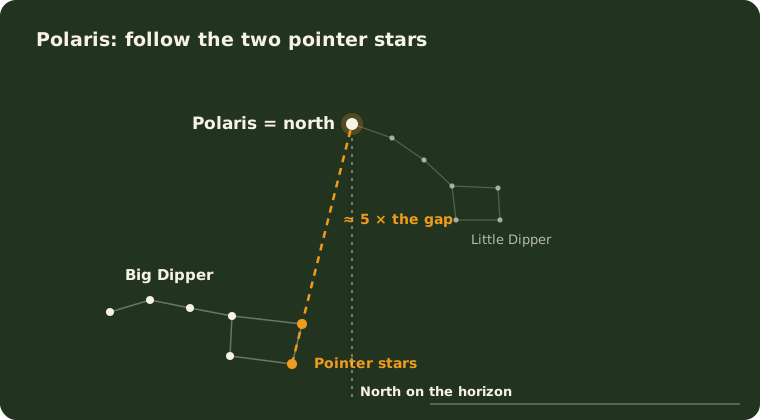
If the Dipper is hidden behind trees, the W of Cassiopeia sits on the opposite side of Polaris at about the same distance. None of this works from the southern hemisphere, where Polaris is below the horizon.
Myths that send people in circles
- Moss grows on the north side. Moss grows where it is damp and shaded — which depends on the slope, the canopy and the wind. In a forest it can be on any side. This myth has walked more people in circles than any other.
- Anthills are on the south side of trees. Ants pick warm, sunny spots; in a forest the sun comes through gaps, not from the south.
- Tree rings are wider on the south side. Rings follow light, slope and neighbours, not the compass — and you would have to cut a tree to look.
- Branches are thicker on the south side. True-ish for a lone tree in a field; in a forest, branches grow towards the gaps.
- "Water always leads to people." Half true. A river often does, and if you are walking out in daylight anyway, following one downstream is a reasonable plan — see what to do if you get lost in the woods. A small stream is not a compass: it can just as well end in a marsh or a ravine.
Near houses there is one honest clue: satellite dishes in the northern hemisphere point roughly south.
North is not the way home
Knowing where north is only helps if you know where you are going relative to it. "The road is to the west of this forest" turns north into a way out; north on its own does not. So the useful habit starts before you walk in: note which side the road is on — or better, save the point where you entered. See how to mark your entry point.
Test yourself
Common questions
How do you find north without a compass during the day? Use the sun: at local noon it is due south and shadows point north. At other times, a shadow stick gives a west–east line in 15–20 minutes; north is perpendicular to it, away from the sun.
How do you find north at night? Follow the two pointer stars of the Big Dipper about five times their distance to Polaris. Directly below it on the horizon is north.
Does moss grow on the north side of trees? Not reliably. Moss grows where it is damp and shaded, which in a forest can be any side of a tree.
Does the watch method work? Roughly. It can be 20° off or more, so use it only to keep a general direction.